

The location, the sport, the country
Get to know Tirana the host city the university sport scene it belongs to, and Albania as the host country.
1. About the host city Tirana
Tirana, the capital and largest city of Albania, is the country's main political, economic, educational, sporting, and cultural centre. Located in central Albania and surrounded by hills and mountains, the city combines a compact urban centre with easy access to natural attractions such as Dajti Mountain and the Grand Park.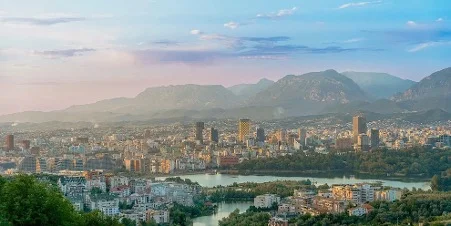
Its architecture reflects different periods of the country's history, from Ottoman landmarks and Italian-style boulevards to colourful residential buildings and modern towers. At the heart of the city lies Skanderbeg Square, surrounded by major landmarks such as the Et'hem Bey Mosque, the Clock Tower, the National Opera and Ballet Theatre, and important public institutions. Other attractions include the Pyramid of Tirana, Bunk'Art, the House of Leaves Museum, the New Bazaar, the Grand Park, and the Blloku district.
One of Tirana's strongest characteristics is its youthful energy. The city is home to a large student population and a growing community of young professionals, entrepreneurs, artists, and volunteers. Its role as European Youth Capital 2022 further strengthened its identity as a city of creativity, participation, and inclusion.
Tirana is also becoming increasingly multicultural. International students, visitors, professionals, and digital workers are contributing to the city's social and cultural life. English, Italian, and other languages are commonly heard in universities, workplaces, cafés, and public spaces.
The city hosts concerts, festivals, exhibitions, sporting events, conferences, and international projects throughout the year. Its lively cafés, restaurants, parks, cultural venues, and nightlife create a welcoming atmosphere for residents and visitors.
2. University sport in the host country
University sport in Albania has a long and meaningful tradition. The country's first recorded participation in international university competitions dates back to 1939, when students from the Liceum of Korça represented Albania at the International University Games organised by the International Confederation of Students placing Albanian students within the emerging international university sports movement.
During the following decades, sport remained an important part of student life in Albania. Physical education programmes, university teams, inter-faculty competitions and national student tournaments provided opportunities for young people to participate in both competitive and recreational activities. Tirana, as the country's main academic centre, became the principal hub of university sport, while universities in other cities gradually developed their own teams and sporting programmes.
A new and more structured chapter began with the formal establishment of the Albanian University Sports Federation (FSHSU) on 21 December 2017. Its creation marked the transition from activities organised largely through individual universities and informal networks to a coordinated national university sports system. The Federation began its first full year of activity in 2018, organising national championships in women's volleyball and men's futsal with the participation of public and private universities.
Today, FSHSU is the national governing body responsible for the development, coordination and representation of university sport in Albania.
FSHSU today by the numbers

Its national calendar includes competitions in sports such as football, futsal, volleyball, basketball, handball, tennis, table tennis, swimming and combat sports. These activities provide students with opportunities to represent their universities, develop their sporting abilities and participate in organised competitions regardless of whether they compete at recreational, university or elite level.
Albania as a host of international university sport
In recent years, Albania has strengthened its position as a host of major international university sporting events.
Looking ahead
University sport in Albania continues to develop through stronger national competitions, increased student participation, international cooperation and the organisation of major events.
FSHSU's vision is to ensure that every student has the opportunity to become involved in sport whether as an athlete, volunteer, organiser, coach, official or supporter. Its work aims to make sport a meaningful part of university life and to use it as a platform for health, education, equality, inclusion and international friendship.
From Albania's first international university sports participation in 1939 to the organisation of major European championships in Tirana, university sport has become an increasingly important part of the country's academic and sporting identity. Through sustained cooperation with universities, institutions and international partners, Albania is building a modern, inclusive and internationally connected university sports system.
University sport in Albania at a glance
3. About the host country Albania
Albania, located in Southeast Europe on the western side of the Balkan Peninsula, is a country distinguished by its rich history, cultural heritage, natural beauty, and renowned hospitality. Situated along the Adriatic and Ionian Seas, Albania offers a unique combination of Mediterranean landscapes, historic cities, mountain regions, and a rapidly developing urban environment.
The country's natural landscape is remarkably diverse. Visitors can experience the beaches of the Albanian Riviera, the dramatic peaks of the Albanian Alps, the lakes of Shkodër, Ohrid, and Prespa, as well as numerous rivers, forests, national parks, and protected natural areas. This diversity makes Albania an attractive destination for outdoor activities, cultural tourism, and international sporting events.
Albania has a history extending over thousands of years, reflected in its archaeological sites, castles, traditional towns, museums, and UNESCO World Heritage properties. The country's cultural identity combines ancient Illyrian heritage, Mediterranean influences, Ottoman-era architecture, and contemporary European culture.